

 https://innews.az/uploads/news/2026-11/_innews_bc4fb5d008211a8968d871e9e_o.jpg
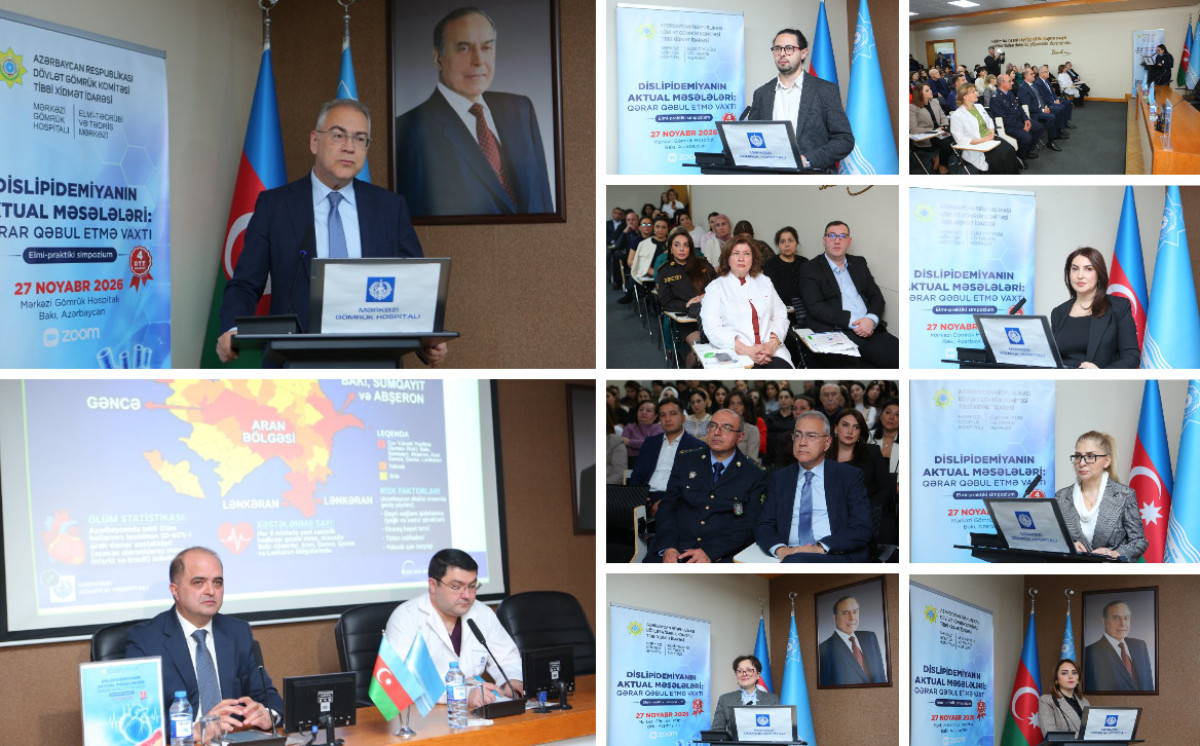
On November 27, a scientific and practical symposium entitled “Current Issues in Dyslipidemia: Time to Make Decisions” was held at the Central Customs Hospital at the initiative of the Medical Service Department of the State Customs Committee of the Republic of Azerbaijan.
The symposium focused on key issues related to the early detection of dyslipidemia in the prevention and treatment of cardiovascular diseases, lipid profile assessment, risk stratification, and the application of modern treatment approaches.
Delivering the official opening remarks, Jeyhun Mammadov, Head of the Medical Service Department of the State Customs Committee, emphasized the importance of managing cardiovascular risk factors. He noted that dyslipidemia plays a significant role in the development of atherosclerosis, which, in turn, can lead to serious cardiovascular conditions such as coronary artery disease, myocardial infarction, and stroke.
Jeyhun Mammadov pointed out that dyslipidemia is asymptomatic in most cases, and sometimes its first manifestation may be a severe complication, such as a myocardial infarction or stroke. Therefore, the primary objective is to identify risks before the onset of disease and make appropriate medical decisions in a timely manner. Highlighting the importance of identifying high-risk groups, implementing screening programmes, assessing individual cardiovascular risks based on examination results, and establishing treatment targets, Mr. Mammadov stressed that although this requires a long-term and systematic approach, it is particularly important for preventing cardiovascular diseases and their complications. In this regard, he placed special emphasis on the importance of lipid profile screening among customs officers by the Medical Service Department.
Subsequently, Rashad Mahmudov, Head of the Scientific, Practical and Training Centre of the Medical Service Department of the State Customs Committee, emphasized that preventing diseases is one of the key priorities alongside their treatment. He noted that even in the absence of any health complaints, it is important to undergo medical examinations, identify potential risks in a timely manner, and take appropriate preventive measures. This approach, based on modern principles of preventive medicine, contributes to maintaining public health, detecting diseases at an early stage, and preventing potential complications in the future.
The first panel session, entitled “Epidemiology, Screening and Early Detection”, was moderated by Rashad Mahmudov, Head of the Scientific, Practical and Training Centre of the Medical Service Department of the State Customs Committee, and Ilgar Tahiroglu, Head of the Cardiology Department of the Central Customs Hospital. The session focused on the early detection of dyslipidemia, the assessment of lipid metabolism, and cardiovascular risk management.
As part of the panel, Sabina Ibrahimova, Head of the Laboratory Department of the Central Customs Hospital and PhD in Biology, delivered a presentation entitled “Lipid Profile Screening Among Employees of the State Customs Committee: Project Overview and Preliminary Results”. Gunay Mammadova, cardiologist at the Hospital's Cardiology Department, presented “The Epidemiology of Atherosclerosis and New Organisational Approaches to Cardiovascular Risk Management”, while cardiologist Gunay Gatamova delivered a presentation entitled “Familial Hypercholesterolemia: Disease Screening, Genetic Diagnosis and Current Treatment Challenges”.
The second panel session, entitled “Treatment Strategies: Time to Make Decisions”, was moderated by Samir Mustafayev, interventional cardiologist at the Central Customs Hospital, and Emin Hajibalayev, cardiologist. The discussion focused on modern strategies for treating dyslipidemia, cardiovascular risk assessment, and achieving individual treatment targets.
During the session, Rahima Gabulova, Associate Professor at Azerbaijan Medical University, delivered a presentation entitled “The Impact of Dyslipidemia on Cardiovascular Risk Stratification and the Relationship Between Lipid Profile and Other Cardiovascular Risk Factors”. Emin Allahverdiyev, interventional cardiologist at the Central Customs Hospital, presented “How Can We Overcome Barriers to Achieving LDL-C Targets? The Benefits of Early Treatment”. Urfan Jafarov, interventional cardiologist at Ege Hospital, delivered a presentation entitled “Management of Patients with Dyslipidemia and Comorbidities: Challenges in Everyday Clinical Practice”. Fuad Samedov, Head of the Cardiology Department at İnci Clinic, presented “A New Chapter in Dyslipidemia Management: Targeted Therapy in Real-World Clinical Practice”.
The symposium was held in an interactive format, featuring panel discussions and question-and-answer sessions.
The event served as an important platform for exchanging modern scientific approaches to the diagnosis and treatment of dyslipidemia, discussing clinical experience, and fostering scientific collaboration among specialists in the prevention and management of cardiovascular diseases.
The scientific symposium was accredited in accordance with the “Regulations on the Accreditation of Scientific and Educational Events for Continuing Medical Education” of the Ministry of Health of the Republic of Azerbaijan and awarded 4 Continuing Medical Education (CME) credits.








Ən son xəbərləri səhifəmizdən də izləyin