

 https://innews.az/uploads/news/2026-07/_innews_16f9ae29ec26455af7e7eaa65_o.jpg
Introduction
The contemporary global economy is evolving amid heightened uncertainty, as energy markets are simultaneously affected by geopolitical conflicts, price volatility, shifts in trade flows, and an accelerating transition to low-carbon technologies. In its April 2026 outlook, the International Monetary Fund notes that the global economy is under pressure from rising commodity prices, inflation risks, and tighter financial conditions. Under the baseline scenario, global growth is projected at 3.1% in 2026; however, a more severe energy shock could reduce it to 2.5%. [1] This indicates that energy security and the resilience of the economic model are becoming not only environmental concerns but also matters of strategic economic importance.
Against this background, green energy is emerging as one of the principal areas of the new global economic competition. According to the International Energy Agency, renewable energy capacity in more than 80% of the world's countries is expected to grow faster during 2025-2030 than it did over the preceding five years. This expansion is nevertheless accompanied by major constraints, including the need to modernise electricity grids, the vulnerability of supply chains, and the requirement for sustainable financing. The energy transition can therefore no longer be viewed merely as the technological replacement of oil, natural gas, or coal with solar and wind power. Under current conditions, it entails the development of a new industrial, investment, and infrastructure policy. [2]
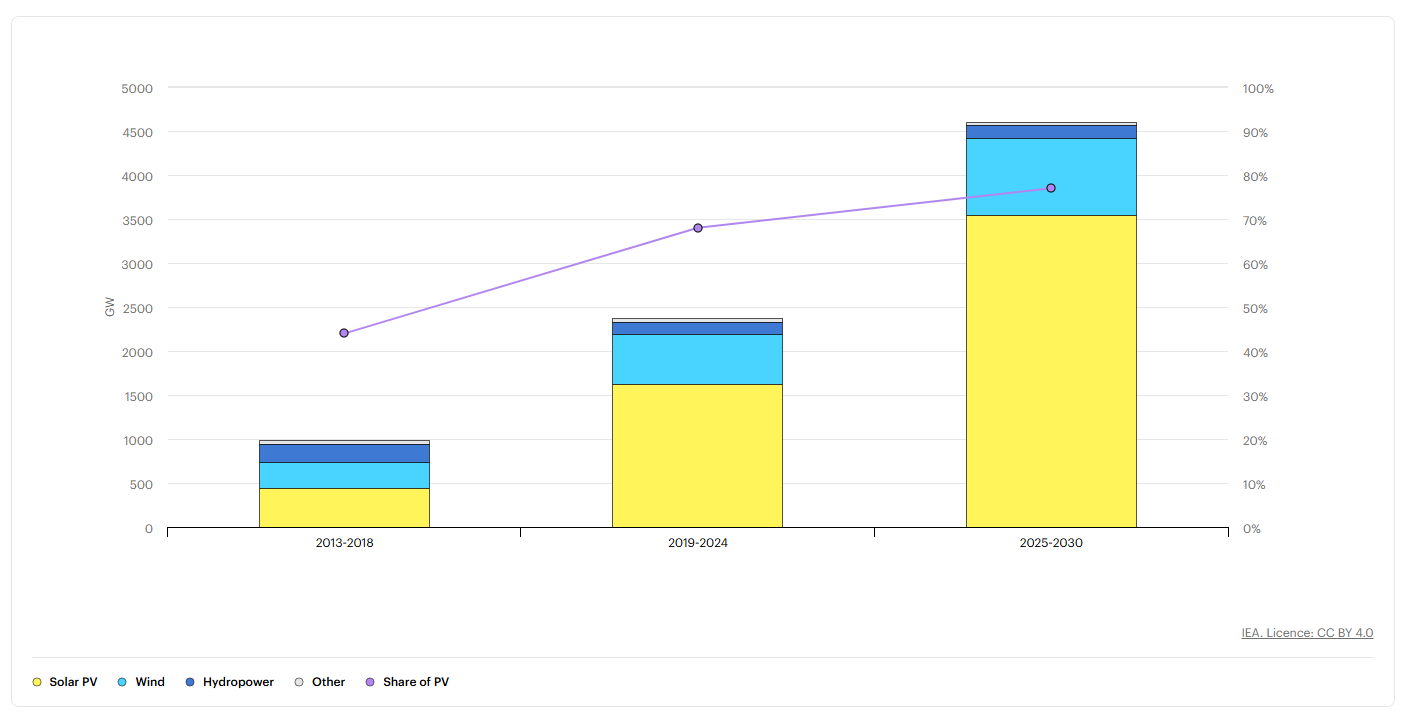
Figure 1. Global renewable power capacity additions by technology, 2013-2030, GW
Source: [2]
Figure 1 illustrates the rapid acceleration in renewable power capacity additions worldwide. While total additions were relatively moderate in 2013-2018, they increased markedly in 2019-2024 and are projected to expand substantially further during 2025-2030. The most significant trend is the growing role of solar photovoltaic power. Solar capacity accounts for the largest share of total additions, and the line shown in the chart indicates that this share continues to rise. This confirms that the contemporary energy transition is driven largely by the rapid scaling of solar generation, although wind power, hydropower, and other renewable sources remain important components of the overall growth structure.
This issue is of particular importance to Azerbaijan. The country has traditionally occupied a significant position in the regional and international energy architecture, primarily because of its oil and gas sector. However, the long-term resilience of the national economy requires the expansion of non-oil sources of growth, the attraction of new investment, the development of modern technologies, and the strengthening of export capacity. In this context, green energy is not only an environmentally important agenda for Azerbaijan but also a major economic instrument of diversification. The country's official target is to raise the share of renewable energy sources in total installed capacity to 30% by 2030, confirming the strategic nature of this policy area. [3] The relevance of the subject is further reinforced by Azerbaijan's ambition not only to develop domestic renewable energy but also to participate in a new system of cross-border green energy exports. The inclusion of the Caspian-Black Sea-Europe Green Energy Corridor projects in the European Network of Transmission System Operators for Electricity's TYNDP 2026 portfolio demonstrates that Azerbaijan's energy transition is gradually acquiring an international infrastructure dimension. This creates opportunities to strengthen the country's role as an energy bridge between the Caspian region and Europe. [4]
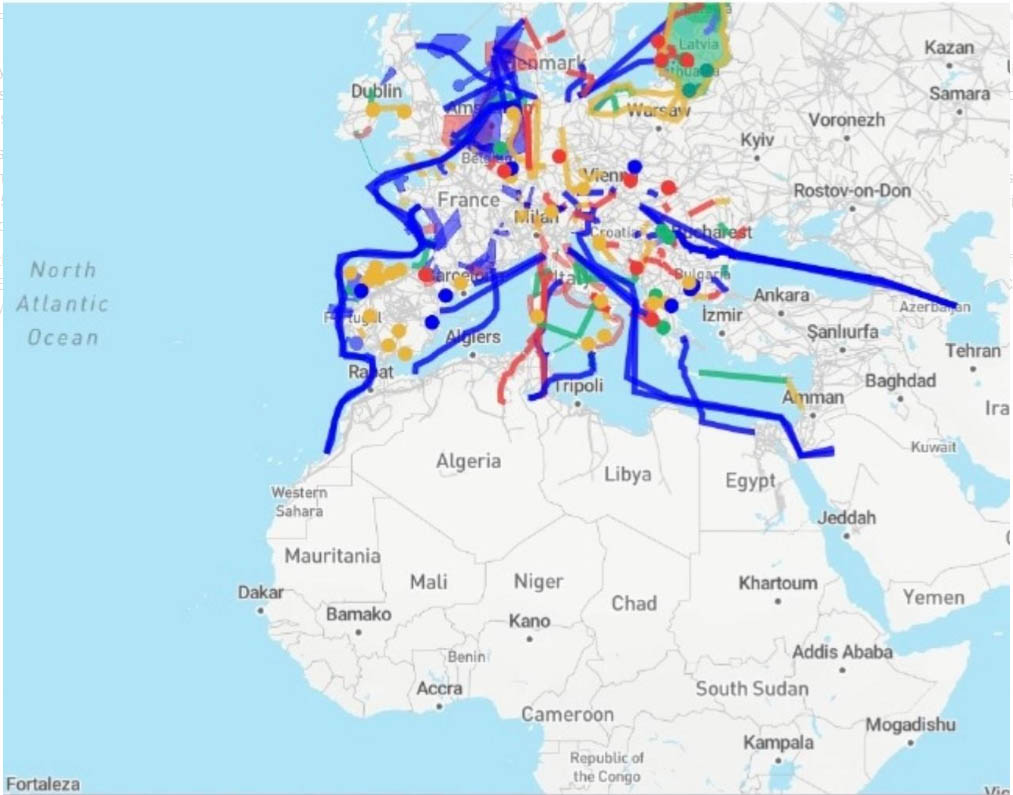
Figure 2. Cross-border electricity interconnections and energy corridors across Europe, the Mediterranean, North Africa, the Middle East, and the South Caucasus
Source: [4]
The map in Figure 2 demonstrates that the development of green energy is inseparable from interregional energy corridors and grid interconnections. In this context, Azerbaijan can be regarded not only as a producer of renewable energy but also as an important link in the future infrastructure for transmitting green electricity between the Caspian region, the South Caucasus, and Europe.
This article aims to analyse how the development of green energy can contribute to the economic diversification of Azerbaijan amid global uncertainty. The central research question is whether the energy transition can become not only an environmental commitment for Azerbaijan, but also a new source of economic growth, investment, and external economic influence. The principal hypothesis is that, provided there is a consistent public policy, modernised grid infrastructure, access to international technologies, and sustained human-capital development, green energy can become an important driver of Azerbaijan's long-term economic resilience and diversification.
Literature Review
Contemporary economic literature and applied analytical reports no longer treat the energy transition solely as an environmental policy; rather, it is increasingly understood as a large-scale process of technological and industrial restructuring. The International Energy Agency states that global renewable electricity capacity could double by 2030, with solar photovoltaic power accounting for almost 80% of the increase. At the same time, renewable energy development faces constraints related to electricity grids, supply chains, and financing. This is particularly relevant to the present analysis, as it demonstrates that green energy requires not only the construction of power plants but also the creation of a new economic infrastructure. [2]
Research and policy reports from the United States place particular emphasis on energy storage, clean hydrogen, grid resilience, and the commercialisation of emerging technologies. The US Department of Energy's Pathways to Commercial Liftoff reports stress that the development of long-duration energy storage requires transparent data on technology costs and performance, modelling tools to assess grid requirements, and financial support for research and demonstration projects. The US approach to clean hydrogen likewise focuses on moving from scientific research to industrial-scale deployment and on establishing a common evidence base for investors, government, and industry. [5] For Azerbaijan, this experience is especially relevant to energy storage, the management of grid flexibility, and the phased introduction of hydrogen solutions.
In academic literature and public policy, the United Kingdom is widely regarded as a leading example of offshore wind development and of institutional mechanisms supporting low-carbon generation. The British Contracts for Difference system is the principal mechanism for supporting new low-carbon electricity projects: it reduces producers' exposure to volatile wholesale prices and improves revenue predictability. In its 2025 update, the UK Government provided for 20-year index-linked contracts for fixed-bottom and floating offshore wind, together with a dedicated budget for floating offshore wind. In addition, the UK's Offshore Wind Industrial Growth Plan links offshore wind development to industrial growth, supply chains, employment, and innovation. This experience is particularly valuable for Azerbaijan in the context of the future development of the Caspian Sea's wind potential. [6]
The Dutch experience demonstrates that the energy transition can be advanced through the integration of offshore wind, hydrogen infrastructure, the port economy, and industrial energy demand. Dutch materials on offshore wind innovation examine solutions for producing hydrogen on offshore platforms, including the PosHYdon project, which is intended to integrate offshore wind power, gas infrastructure, and hydrogen technologies. The Port of Rotterdam is also presented as an emerging hydrogen hub that combines production, industrial use, imports, and the transit of hydrogen to North-Western Europe. [7] This experience is relevant to Azerbaijan because the country possesses both a maritime energy area in the Caspian Sea and a strategic logistics position that could eventually connect green energy production with export infrastructure.
Chinese literature and practice relating to the energy transition are distinguished by the scale of solar and wind deployment, declining technology costs, and an active industrial policy. According to China's National Energy Administration, the country added 373 million kW of new renewable energy capacity in 2024, of which 278 million kW was solar and 79.82 million kW was wind capacity. The International Energy Agency characterises China as a clean-energy powerhouse and notes that its strong manufacturing base, large domestic market, and public support have secured a leading position in the production of clean technologies. [8] For Azerbaijan, China's experience is useful not as a model for direct replication, but as an example of how technological scale can reduce capital costs and accelerate the formation of a new industrial sector.
A comparison of these four approaches yields an important conclusion. The United States provides particularly relevant experience in energy storage, hydrogen, grid resilience, and the commercialisation of innovation. The United Kingdom and the Netherlands are especially advanced in offshore wind, maritime infrastructure, and institutional mechanisms for supporting new energy industries. China demonstrates the advantages of large-scale manufacturing, rapid deployment of solar and wind capacity, and a systemic role for the state in building a clean-energy industry. These approaches have practical significance for Azerbaijan, which, as noted above, aims to raise the share of renewables in installed capacity to 30% by 2030, is developing green energy zones, and regards offshore wind as a promising area of future growth. [9]
At the same time, the literature review shows that existing sources provide extensive analysis of technologies, national energy-transition models, and public support mechanisms, while giving comparatively less attention to their adaptation to the Azerbaijani economy. This gap defines the central task of the present article: in addition to describing international experience, it seeks to identify which elements of the US, British, Dutch, and Chinese approaches could be applied in Azerbaijan, taking account of the country's energy structure, Caspian potential, export orientation, and the Caspian-Black Sea-Europe Green Energy Corridor project included in the TYNDP 2026 portfolio.
Research methodology
This article adopts an analytical and comparative approach and is structured as an academic study. Its principal objective is to examine green energy from an economic perspective as a factor in the diversification of Azerbaijan's economy. Accordingly, the analysis focuses not on the engineering characteristics of individual technologies, but on their potential effects on investment, employment, export capacity, non-oil-sector development, and the resilience of the national economy.
The methodological foundation of the article is a comparative analysis of international experience. It examines the approaches of the United States, the United Kingdom, the Netherlands, and China, as these countries have achieved significant results in different areas of the energy transition. The United States is relevant in terms of energy storage, hydrogen technologies, and grid resilience; the United Kingdom in the development of fixed-bottom and floating offshore wind; the Netherlands as an example of integrating the port economy, hydrogen infrastructure, and offshore energy; and China as a country that has achieved large-scale growth in solar and wind generation.
A second important method is adaptive analysis. This means that international experience is considered not as a ready-made model for direct replication, but as a source of specific technological, institutional, and economic solutions that may be applicable in Azerbaijan under national conditions. These conditions include the country's energy structure, renewable energy potential, Azerbaijan's role in international energy corridors, investment capacity, the state of infrastructure, and the need to develop non-oil sectors.
The study draws on official documents of Azerbaijan, materials issued by international organisations, analytical reports from specialised energy institutions, academic publications, and data from public authorities in the countries examined. This approach makes it possible to combine a theoretical understanding of the energy transition with a practical assessment of its economic significance for Azerbaijan.
A limitation of the study should also be acknowledged. The article does not attempt to provide a comprehensive technical or engineering assessment of solar, wind, hydrogen, or grid projects. Its objective is narrower and explicitly economic: to demonstrate how green energy development and the adaptation of international experience may contribute to the diversification of Azerbaijan's economy, the attraction of investment, and the strengthening of the country's long-term resilience amid global turbulence.
Research Findings
Under contemporary conditions, the energy transition should not be understood simply as the replacement of conventional energy sources with renewable alternatives. Its economic significance is much broader: it changes the structure of investment, generates demand for new technologies, requires infrastructure modernisation, and creates new industrial sectors. According to the International Energy Agency, global energy investment was expected to reach US$3.3 trillion in 2025, with approximately US$2.2 trillion directed towards renewable energy, nuclear power, electricity grids, storage, low-emission fuels, energy efficiency, and electrification. This demonstrates that green energy has become one of the principal destinations of global capital. [10]
Table 1. Trends in global investment in clean energy and fossil fuels, 2015-2025
| Year / period | Investments in fossil fuels | Investments in clean energy | Key conclusion |
| 2015 |
Higher than investment in clean energy |
Lower than investment in fossil fuels |
At the beginning of the period, conventional energy still retained an investment advantage. |
| 2016-2019 |
Relatively stable, with no pronounced growth |
Gradually exceeds investment in fossil fuels |
A structural shift in global energy investment towards clean energy begins. |
| 2020 |
Decline amid crisis conditions |
Maintains a more resilient trend |
Clean energy demonstrates greater investment resilience than conventional energy sources. |
| 2021-2023 |
Moderate recovery |
Rapid growth |
The gap between clean-energy and fossil-fuel investment widens substantially. |
| 2024 |
Approximately US$1.2 trillion |
More than US$2 trillion |
Clean energy becomes the principal destination of global energy investment. |
| 2025 |
Approximately US$1.1 trillion |
Approximately US$2.2 trillion |
Investment in clean energy is approximately twice the amount invested in fossil fuels. |
Source: compiled by the author on the basis of [10]
Table 1 demonstrates a profound structural shift in the global energy economy. Whereas investment in fossil fuels still exceeded investment in clean energy in 2015, the position had reversed by 2025. According to the International Energy Agency, approximately US$2.2 trillion was directed towards clean energy in 2025, including renewables, electricity grids, storage, low-emission fuels, energy efficiency, and electrification, while approximately US$1.1 trillion was allocated to oil, natural gas, and coal. This confirms that the energy transition is becoming not only an environmental process but also the principal direction of global capital allocation. For Azerbaijan, this trend is important because green energy development can serve as a means of attracting investment, diversifying the economy, and strengthening the country's position in the emerging energy architecture. [10]
From a theoretical perspective, green energy can contribute to economic diversification through several channels. First, it attracts investment not only in electricity generation but also in related fields, including grids, energy storage, digital power-system management, maintenance services, and workforce development. Second, it facilitates technology transfer, since large-scale projects commonly require international partnerships, engineering solutions, modern management standards, and new competencies. Third, it creates the basis for the gradual development of new domestic value chains.
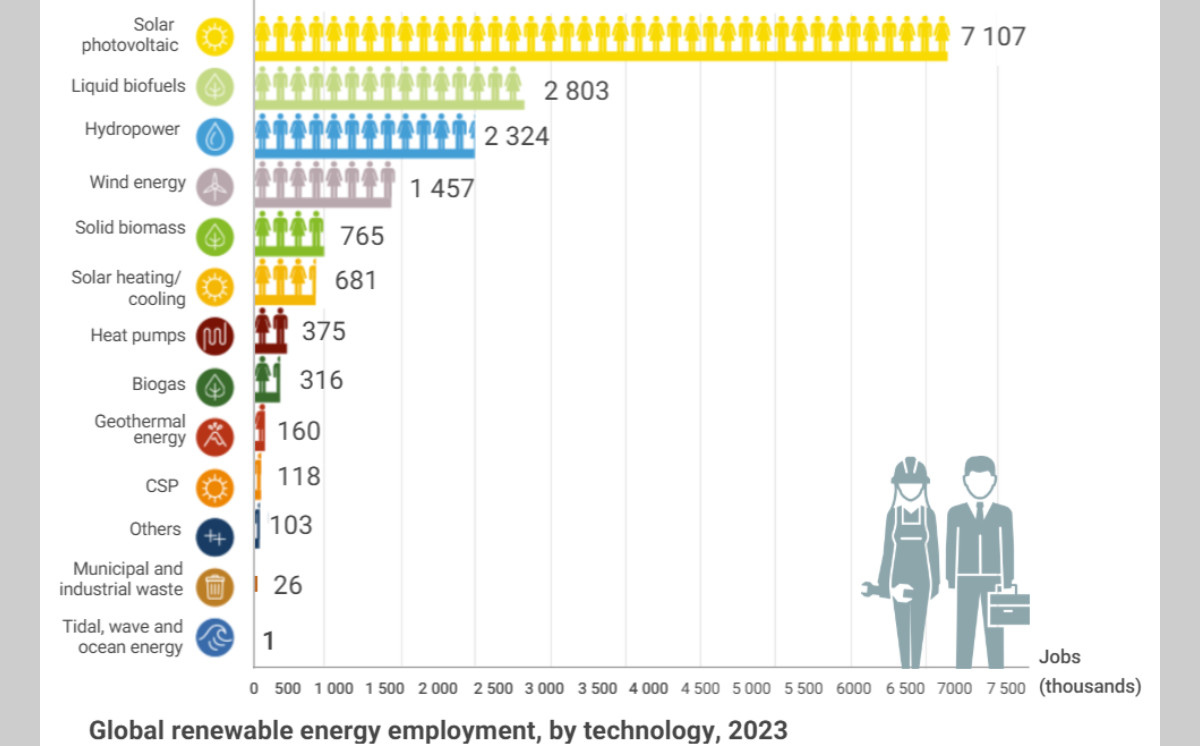
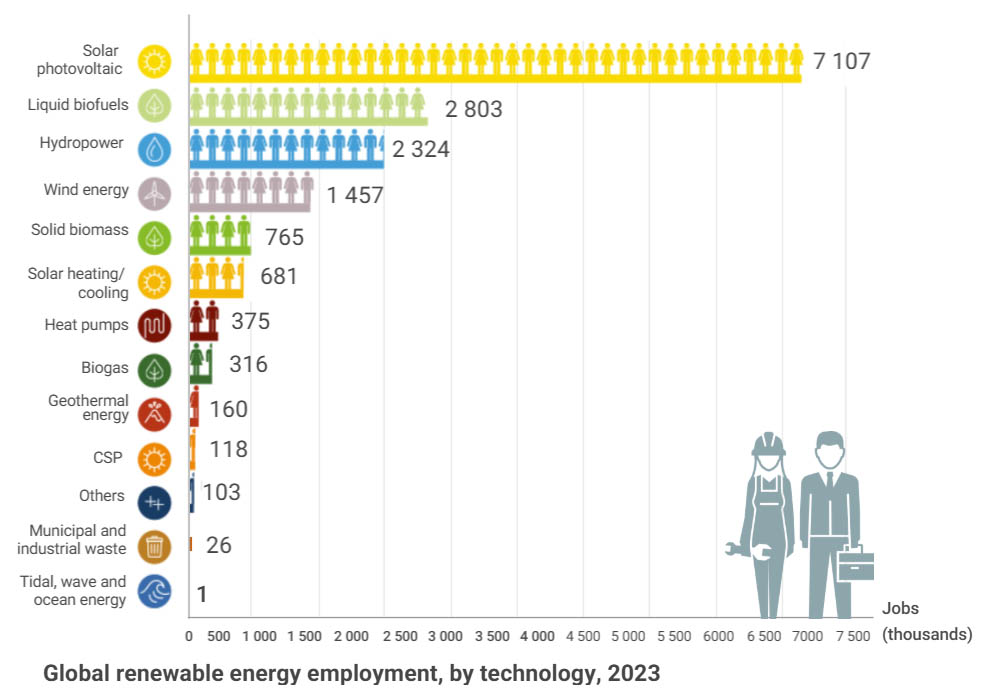
Employment is another important dimension. Renewable energy creates jobs not only during power-plant construction, but also in design, operations, maintenance, logistics, equipment manufacturing, and power-system management. According to IRENA and the International Labour Organization, at least 16.2 million people were employed in the global renewable energy sector in 2023. Green energy is therefore significant not only as a source of electricity, but also as a sector capable of creating new occupational skills and employment opportunities. [11]
Figure 3. Global renewable energy employment by technology in 2023, thousands of jobs
Source: [11]
Figure 3 shows that renewable energy is not only a source of clean electricity but also a major source of employment. Solar photovoltaic power accounted for the largest number of jobs in 2023, at approximately 7.1 million. It was followed by liquid biofuels with 2.8 million jobs, hydropower with 2.3 million, and wind energy with 1.46 million. These figures confirm that the energy transition creates new economic opportunities across engineering, manufacturing, services, logistics, and research.
This approach is particularly important for Azerbaijan, which has a strong traditional oil and gas base but also seeks to expand non-oil sources of growth. In the short term, green energy need not replace the oil and gas sector; rather, it can complement it by providing an additional pillar for the economy. [12]
Export potential is also of particular significance. A country that develops solar, wind, and, in the longer term, hydrogen projects gains the capacity not only to meet domestic demand but also to participate in new regional energy linkages. This is especially relevant to Azerbaijan in view of the planned green energy corridors and the country's geographical position between the Caspian region, the South Caucasus, and Europe. Green energy can therefore reinforce both domestic economic diversification and Azerbaijan's external economic role.
International experience shows that there is no single universal model of the energy transition. Each country develops the areas that correspond to its resources, industrial base, and economic interests. For Azerbaijan, it is particularly useful to consider the experience of the United States, the United Kingdom, the Netherlands, and China, since these countries demonstrate different but complementary approaches to green energy development, ranging from innovation and grid resilience to offshore wind, hydrogen infrastructure, and the mass production of clean technologies.
The US experience is important primarily because the United States treats the energy transition as both a technological and an infrastructure challenge.
A US Department of Energy report on long-duration energy storage emphasises the need for transparent data on technology costs, new models for evaluating storage solutions, financial support for research and demonstration projects, and market mechanisms that enable private capital to invest in such technologies. [13] This has practical significance for Azerbaijan, because the expansion of solar and wind generation will inevitably require energy storage and a more flexible power system.
A second important area is clean hydrogen. The US Department of Energy regards it as a means of decarbonising sectors in which direct electrification is difficult, including ammonia production, petrochemicals, and heavy transport. [14] This experience may be useful to Azerbaijan over the longer term. Hydrogen should not be regarded as an immediate substitute for conventional energy resources, but it could form part of a future export and industrial strategy where projects are economically viable.
US policy on smart grids also merits particular attention. The Grid Resilience and Innovation Partnerships programme is intended to increase power-system flexibility and resilience, while Smart Grid Grants support investment in greater grid capacity, renewable-energy integration, and technologies with the potential for broader market deployment. [15] This is especially relevant to Azerbaijan, because without a modernised grid, green energy development will be constrained by technical bottlenecks.
The United Kingdom is relevant as a country that has established an advanced institutional model for supporting low-carbon energy.
Its principal instrument is the Contracts for Difference system, which reduces price risk for investors and improves project predictability. In the seventh allocation round, particular emphasis was placed on offshore and floating offshore wind: the total round budget was revised to GBP 1.97 billion, of which GBP 1.79 billion was allocated to offshore wind and GBP 180 million to floating offshore wind. [16] The UK example is relevant to Azerbaijan not only because of the wind technologies themselves, but also because it demonstrates how a market can be created. Offshore wind requires substantial capital investment, a long investment horizon, transparent grid-connection rules, and a clear mechanism for electricity sales. British experience may therefore assist Azerbaijan in developing support mechanisms for future Caspian wind projects, particularly if those projects are intended not only to meet domestic demand but also to export green electricity.
The Netherlands is important to the analysis as an example of a country that links the energy transition with the maritime economy, port infrastructure, and industrial energy demand.
The Netherlands Enterprise Agency reports that the country had reached 4.7 GW of offshore wind capacity by the end of 2023 and aims to achieve 21 GW of installed capacity under the current roadmap. At the same time, the Netherlands explicitly acknowledges that offshore energy development faces rising costs and insufficient demand and is therefore moving towards more sophisticated support instruments, including future two-sided Contracts for Difference. [17]
The experience of Rotterdam is particularly relevant to Azerbaijan. The Port of Rotterdam is developing a large-scale hydrogen network intended to connect hydrogen production, imports, use, and transportation across North-Western Europe. [18] This demonstrates that green energy is becoming part not only of the electricity sector, but also of logistics, industry, and foreign trade. Given Azerbaijan's position on the Caspian Sea and its transit function, the Dutch model is instructive as an example of integrating energy, port infrastructure, and future export chains.
The Chinese experience is distinguished above all by its scale.
As noted above, China added 373 million kW of new renewable energy capacity in 2024, including 278 million kW of solar capacity and 79.82 million kW of wind capacity. By the end of 2024, total installed renewable energy capacity had reached 1.889 billion kW, equivalent to 56% of the country's entire installed capacity. These figures show that China's energy transition is not a separate strand of environmental policy, but part of a large-scale industrial and infrastructure strategy. [19] From Azerbaijan's economic perspective, China's experience in reducing technology costs through scale, industrial coordination, and the development of manufacturing value chains is particularly important. The International Energy Agency notes that China is the lowest-cost location for manufacturing key clean-energy technologies, while producing solar modules, wind turbines, and batteries is considerably more expensive in the United States and the European Union. For Azerbaijan, cooperation with Chinese companies may therefore improve access to equipment, accelerate construction, and reduce capital expenditure. Such cooperation should, however, be accompanied by requirements concerning quality, the localisation of selected activities, workforce training, and technological learning.
Azerbaijan is among the countries in which the energy transition has a distinct economic character. On the one hand, the country has a strong conventional energy base: oil and natural gas have historically played a central role in exports and in fiscal and economic stability. Oil and gas account for more than 90% of Azerbaijan's exports, and the economy's high dependence on extractive industries makes it sensitive to fluctuations in global oil prices. [20] Green energy is therefore important to Azerbaijan not as an immediate substitute for the oil and gas sector, but as a new avenue for broadening the economic model. On the other hand, Azerbaijan has already established a policy framework for renewable energy development. Key objectives include increasing the share of renewable energy and transforming the liberated territories into a green energy zone. This again confirms that Azerbaijan regards the energy transition not as an isolated environmental project, but as an element of the national development strategy. The economic potential of this direction is reinforced by the resource base. According to Azerbaijan's Energy Regulatory Agency, the technical renewable energy potential is estimated at 135 GW onshore and 157 GW offshore. [21]
Although the practical utilisation of this potential will require time, investment, and infrastructure, the scale of the resources indicates that renewable energy can become an independent area of investment-led development in Azerbaijan.
Electricity-grid modernisation is of particular importance. Without strong grid infrastructure, it is impossible to connect large solar and wind plants efficiently, maintain power-system stability, or prepare export routes. In 2025, the World Bank approved the AZURE project, which is intended to strengthen Azerbaijan's transmission network, diversify the energy mix, and create a more resilient power system. [22] This confirms that Azerbaijan's energy transition is gradually moving from policy objectives towards infrastructure implementation.
Another important element concerns green electricity exports. The inclusion of the first and second phases of the Caspian-Black Sea-Europe Green Energy Corridor in the European Network of Transmission System Operators for Electricity's TYNDP 2026 portfolio demonstrates that Azerbaijan can participate not only in domestic renewable energy generation but also in the formation of cross-border energy infrastructure. [4] This is especially important for strengthening the country's role as an energy bridge between the Caspian region and Europe.
The above analysis indicates that Azerbaijan's energy-transition agenda combines three elements: a traditional oil and gas foundation, growing renewable energy potential, and the development of new infrastructure for domestic consumption and exports. Green energy should therefore be viewed not as a short-term abandonment of the existing energy model, but as its gradual expansion. In economic terms, it can promote diversification, attract investment, create new competencies, and reduce the country's exposure to commodity-price volatility.
Analysis
The principal conclusion from international experience is that Azerbaijan should not mechanically transplant foreign energy-transition models. A more appropriate approach is to select those elements from different countries that correspond to national conditions: the Caspian Sea's resource potential, Azerbaijan's role in energy corridors, the need for economic diversification, and the requirement to modernise electricity grids. In this respect, the experience of the United States, the United Kingdom, the Netherlands, and China can serve as a practical toolkit.
From the United States, Azerbaijan can draw primarily on approaches to energy storage, grid resilience, and innovative financing. For a country planning to expand solar and wind generation, storage is critical: renewable output depends on weather conditions, and the power system must therefore be flexible. US Department of Energy reports on long-duration energy storage show that the commercialisation of such technologies requires not only research and development, but also demonstration projects, transparent cost calculations, clear market rules, and private-capital participation. For Azerbaijan, this means developing not only generation facilities, but also storage systems, load-management capabilities, and financing mechanisms for pilot projects. US experience is also relevant to grid modernisation. Azerbaijan is already moving in this direction: in 2025, the World Bank approved the AZURE project to reinforce the transmission network, diversify the energy mix, and improve power-system reliability. This confirms that the transition to green energy cannot proceed without first strengthening infrastructure. The most rational sequence for Azerbaijan is therefore to reinforce the grid and system management first, connect new solar and wind capacity at scale second, and develop green electricity exports third.
The UK's experience is particularly useful to Azerbaijan in the development of offshore wind and the establishment of clear rules for investors. The British Contracts for Difference system demonstrates that public support can do more than subsidise an industry: it can reduce investment risk and facilitate the creation of new markets. This is particularly important for Azerbaijan because developing the wind potential of the Caspian Sea will require long-term capital, transparent grid-connection rules, electricity-purchase mechanisms, and assurances of predictable revenue. According to the offshore wind roadmap prepared by Azerbaijan's Ministry of Energy, the World Bank, and IFC, the country could install up to 7 GW of offshore wind capacity by 2040 if supported by a long-term vision, infrastructure, investment, and appropriate policy. [23] British experience also highlights an important limitation: offshore wind does not develop on the basis of natural potential alone. It requires institutions, auctions, offshore site preparation, grid planning, qualified contractors, and a system for allocating risk between the state and investors. A phased model is therefore the most appropriate for Azerbaijan: feasibility studies, pilot projects, workforce development, and only then commercial-scale deployment. Official UK Government materials on Allocation Round 7 show that even a mature offshore wind market continues to require dedicated instruments supporting low-carbon projects. [24]
The Dutch experience is especially valuable because it integrates energy, port infrastructure, hydrogen, and industrial logistics. This matters to Azerbaijan because the country has not only energy resources but also a strategic transit position. In the future, green energy may be linked not only to electricity generation, but also to export logistics, industrial zones, port facilities, and potential hydrogen value chains. As noted above, hydrogen infrastructure is already being developed in Rotterdam: construction is under way on the first section of the national hydrogen network in the port area, which is intended to provide the foundation for future links across the Netherlands and with Germany and Belgium. For Azerbaijan, the Dutch model is useful as an integrated framework: wind energy cannot and should not be considered separately from ports, logistics, industrial demand, and exports. Caution is nevertheless required. Green hydrogen remains capital-intensive and technically complex, and should therefore be regarded as a long-term opportunity for Azerbaijan rather than an immediately commercial proposition. At the initial stage, priority should be given to assessing demand, production costs, infrastructure requirements, and potential external markets.
China offers Azerbaijan a different but equally important lesson concerning scale, industrial organisation, and technology-cost reduction. China's experience shows that the energy transition can become part of industrial policy rather than remaining solely an environmental strategy. For Azerbaijan, this may be useful in the construction of solar and wind facilities, equipment procurement, capital-cost reduction, and accelerated project implementation. Cooperation with China should nevertheless be designed on a sound economic basis. China is the lowest-cost manufacturing location for key clean-energy technologies, while solar modules, wind turbines, and batteries are considerably more expensive to produce in the United States and the European Union. This creates an opportunity for Azerbaijan to reduce project costs, but cooperation should not be confined to equipment imports. It should include specialist training, maintenance services, the transfer of practical competencies, and, where feasible, the localisation of selected activities.
The constraints of the energy transition must also be recognised. Even advanced economies face grid bottlenecks, rising project costs, shortages of skilled personnel, and changes in public policy. In its renewable energy outlook for 2025-2030, the International Energy Agency reduced its global growth forecast by 5% compared with the previous year because of changes in policy, regulation, and market conditions. This is an important signal for Azerbaijan: green energy has considerable potential, but its development requires realistic planning, sustainable financing, and effective risk management. [25]
The practical conclusion for Azerbaijan can be summarised as follows. The country should draw on US approaches to energy storage, smart grids, and innovative financing; British mechanisms for launching offshore wind and reducing investment risk; the Dutch model of integrating ports, hydrogen, wind energy, and export logistics; and China's experience in scaling solar and wind technologies and lowering capital costs. All these elements must, however, be adapted to Azerbaijan's national circumstances, including the condition of the grid, investment capacity, workforce capabilities, the role of the Caspian Sea, and the prospects of the Caspian-Black Sea-Europe Green Energy Corridor. The energy transition should be pursued as a coherent economic strategy comprising four stages: grid reinforcement, pilot projects, the attraction of technology and capital, and finally the development of an export-oriented green energy model. Such sequencing can transform green energy from a discrete environmental policy area into a genuine driver of economic diversification.
Conclusions and Recommendations
The analysis demonstrates that green energy should be regarded in Azerbaijan not as a short-term replacement for the oil and gas sector, but as a new avenue for economic diversification. As noted above, a sustained investment shift has already taken place in the global economy. According to the International Energy Agency, global energy investment was expected to reach US$3.3 trillion in 2025, of which approximately US$2.2 trillion was directed towards clean energy, grids, storage, energy efficiency, and electrification - roughly twice the amount invested in oil, natural gas, and coal. The energy transition is therefore becoming not only an environmental process but also one of the principal destinations of global capital. This development is of particular importance to Azerbaijan. The country has set a target of raising the share of renewable energy sources in total installed electricity capacity to 30% by 2030 and of developing the liberated territories as a green energy zone. Green energy can consequently become an instrument for attracting investment, creating new competencies, expanding the non-oil sector, and strengthening Azerbaijan's external economic role.
The first recommendation is that green energy development should begin not only with the construction of new solar and wind plants, but also with the reinforcement of electricity-grid infrastructure. Without a reliable grid, renewable sources cannot be connected securely, loads cannot be managed effectively, and green electricity exports cannot be prepared.
The second recommendation is to develop energy storage and digital power-system management. Solar and wind generation depend on natural conditions, and their expansion must therefore be accompanied by technologies for energy storage, generation forecasting, load balancing, and intelligent grid management. This would enable Azerbaijan not merely to increase installed capacity, but to build a more flexible and resilient power system.
The third recommendation is to develop Caspian offshore wind in stages. Initially, emphasis should be placed on feasibility studies, pilot projects, assessments of grid capacity, workforce preparation, and the engagement of reliable international partners. This approach would reduce investment and technical risks and prevent the premature launch of large projects before the necessary infrastructure is in place.
The fourth recommendation is to pursue international cooperation selectively. Azerbaijan should draw on US experience in storage, grid resilience, and innovative financing; British experience in offshore wind development and support for emerging markets; Dutch experience in integrating ports, hydrogen, wind power, and logistics; and Chinese experience in scaling solar and wind technologies and reducing capital expenditure. These models should not be replicated mechanically, but adapted to Azerbaijan's national circumstances.
The fifth recommendation is to link green energy development with workforce training and the localisation of competencies. If new projects rely exclusively on imported equipment and foreign contractors, their long-term economic impact will remain limited. It is therefore essential to develop domestic engineering, technical, managerial, and research capabilities, with the participation of universities, vocational training centres, and specialised research and applied-science institutions.
The sixth recommendation is to treat green energy as part of Azerbaijan's export strategy. The inclusion of the first and second phases of the Caspian-Black Sea-Europe Green Energy Corridor in the TYNDP 2026 portfolio shows that the country can participate in the creation of a new cross-border energy infrastructure. This creates an opportunity not only to produce renewable energy for the domestic market, but also to strengthen Azerbaijan's role as an energy bridge between the Caspian region and Europe.
In conclusion, Azerbaijan's energy transition should be implemented as a coherent and sequential economic strategy. Its core logic may comprise four stages: grid reinforcement, the launch of pilot projects, the attraction of technology and investment, and the subsequent development of an export-oriented green energy model. Under this approach, green energy can become not a supplementary policy area, but a major contributor to the long-term diversification, investment attractiveness, and resilience of Azerbaijan's economy amid global uncertainty.
REFERENCES
1. https://www.imf.org/en/publications/weo/issues/2026/04/14/world-economic-outlook-april-2026
2. https://www.iea.org/reports/renewables-2025/executive-summary
3. https://minenergy.gov.az/en/xeberler-arxivi/00226
4. https://minenergy.gov.az/en/xeberler-arxivi/00653
8. https://english.www.gov.cn/archive/statistics/202501/28/content_WS6798de96c6d0868f4e8ef410.html
9. https://area.gov.az/en/page/haqqimizda
10. https://www.iea.org/reports/world-energy-investment-2025/executive-summary
11. https://www.irena.org/Energy-Transition/Socio-economic-impact/Energy-and-Jobs
12. https://www.eu4environment.org/app/uploads/2024/04/Azerbaijan-Renewable-Energy-Sector.pdf
15. https://www.energy.gov/oe/grid-resilience-and-innovation-partnerships-grip-program-projects
17. https://english.rvo.nl/topics/offshore-wind-energy/new-offshore-wind-farms
18. https://www.portofrotterdam.com/en/port-future/energy-transition/ongoing-projects/hydrogen-rotterdam
19. https://www.iea.org/reports/energy-technology-perspectives-2024
20. https://www.iea.org/reports/azerbaijan-energy-profile/overview
21. https://regulator.gov.az/en/tenzimlenen-muessiseler/investisiya-muhiti
25. https://www.iea.org/reports/renewables-2025/renewable-electricity

Haji Farah Mammad 01.11.2010 school 18









Ən son xəbərləri səhifəmizdən də izləyin