

 https://innews.az/uploads/news/2025-12/_innews_21de7ea54865a99215cc88fec_o.jpg
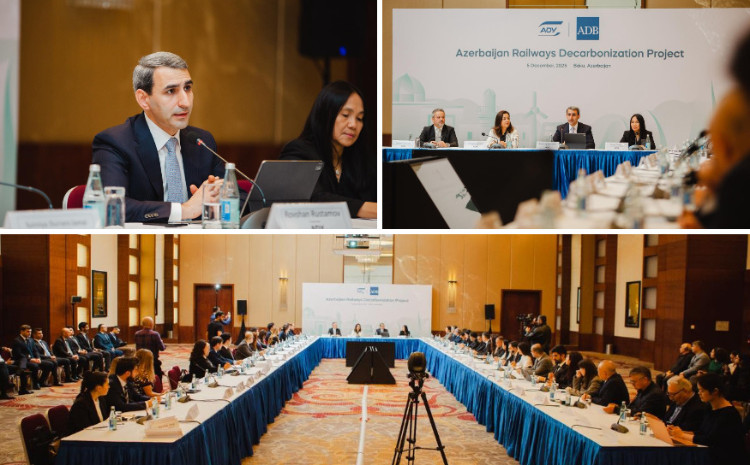
A decarbonization project has been presented within the framework of the partnership between Azerbaijan Railways CJSC (ADY) and the Asian Development Bank (ADB). Supported by the Asian Development Bank, the project aims to reinforce Azerbaijan’s national climate commitments and accelerate the transition of the country’s railway system towards sustainability. In this regard, the technical, financial, economic, environmental, and social aspects will be thoroughly analysed. This new initiative will fast-track the transition to a low-carbon, modern, and competitive railway system in the country.
ADY is currently the first state-owned railway company in the Caucasus and Central Asia to carry out a comprehensive decarbonization program in partnership with the Asian Development Bank.
The “ADY Decarbonization Policy and Framework Document” has already been prepared by the parties. The project launched today will support the practical implementation of this strategic framework and facilitate the preparation of a fully structured investment program for renewable energy across the railway infrastructure.
The Asian Development Bank will support Azerbaijan Railways by enhancing its capacity in waste monitoring and reporting, identifying technological opportunities to accelerate the company’s decarbonization efforts, and conducting studies on renewable energy sources. The Bank will also contribute to the development of workshops and training programs on ESG principles, sustainability practices, and compliance requirements, and will take an active role in implementing regional twinning initiatives. As part of the application of ESG principles, ADY’s initiatives also aim to promote gender equality, create an inclusive work environment, and enhance women’s participation in decision-making and governance.
Rovshan Rustamov, Chairman of ADY, noted during his speech that the project plays a key role in turning the priority areas outlined in the Strategic Development Directions of Azerbaijan Railways until 2030—including decarbonization, digitalisation, corridor competitiveness, and safety—into practical, results-oriented actions. He emphasised that the importance of the project is particularly pronounced today, as Azerbaijan is transforming into a strategic transit hub along the East–West and North–South transport corridors:
“The growth in freight transportation along the Middle Corridor and the North–South route requires strengthening the railway system in terms of efficiency, reliability, and environmental responsibility – and decarbonization is precisely what enhances these capabilities even further.” The project, implemented with the initiative and financial support of the Asian Development Bank is considered an important step toward ensuring sustainable development in the country’s railway sector. The USD 1.25 million in technical assistance provided by ADB creates favourable conditions for preparatory activities focused on enhancing energy efficiency, expanding electrification, and reducing emissions across the railway infrastructure. Within the framework of the project, a phased transition away from diesel-powered rolling stock is envisaged, along with the integration of renewable energy sources-particularly solar power-into stations and service facilities. The decarbonization initiative represents an important milestone for ADY and further strengthens the company’s efforts toward achieving Azerbaijan’s targets of reducing greenhouse gas emissions to 35% for 2030 and to 40% for 2035. Even though its share in the country’s total emissions is below 0.5%, ADY maintains a strong commitment to supporting and advancing decarbonization measures.
In recent years, ADY has taken several important steps in its decarbonization initiatives. Over the past year alone, natural gas consumption has decreased by 50%, 63% of the railway network has been electrified, and more than 80% of freight transportation has been carried out using electric locomotives. At ADY’s Bilajari and Ganja locomotive depots, which are equipped with advanced technological systems, over 650 solar panels have been installed, resulting in a 50% increase in ‘green energy’ production compared to 2023.
Advancements in digitalisation also constitute an integral part of ADY’s modernisation process. Cooperation with ADB further strengthens this direction, enabling the introduction of fully electronic document circulation for freight operations and digital signature systems for station managers, freight agents, and weight controllers.
As part of the decarbonization project, a feasibility study will be conducted to identify opportunities to integrate renewable energy, deploy energy storage technologies, enhance operational efficiency, and develop long-term emission-reduction strategies.
The planned measures will help position railways as a ‘net-zero’ mode of transport, achieving full decarbonization.
It should be noted that ADY’s cooperation with ADB and other international financial institutions contributes to infrastructure modernisation, corridor development, and the optimisation of climate action, thereby strengthening the company’s regional standing.








Ən son xəbərləri səhifəmizdən də izləyin